Free & Confidential Consultation • Proudly Standing With Organized Labor • Hablamos Español
Home > Workers’ Compensation > Chicken Plant Injuries
Georgia Poultry Processing Workers’ Comp Attorneys

Georgia Chicken Plant Injury Lawyers

Built the Industry. Earned Your Benefits.

Georgia is the nation’s #1 poultry state — and the workers who debone, cut, and pack millions of birds a day pay for that output with their bodies. When the line moves too fast and the injuries mount, Morrison & Hughes fights to get poultry workers the medical care and wage benefits the law promises. Your claim is valid regardless of your immigration status.

We handle denied & delayed claims
Se habla español
6 office locations statewide
#0
Poultry-Producing State
Georgia leads U.S. broiler output (UGA CAES)
$0B+
Annual Economic Impact
GA poultry industry (Georgia Poultry Federation)
0%
Workers Hurt on the Job
Reported a significant injury/illness (SPLC survey)
0M
Lbs of Chicken / Day
Produced in Georgia daily (UGA CAES)
Representing Georgia Poultry Workers

The Line Never Stops. Neither Do We.

Georgia has been the country’s top poultry-producing state for more than 15 years. The industry generates over $4.3 billion in farm-gate value and an economic impact exceeding $28 billion a year, and on an average day the state turns out roughly 29 million pounds of chicken. That output runs on people — tens of thousands of Georgians standing shoulder to shoulder on processing lines in Gainesville, Carrollton, Cumming, and across north and middle Georgia.

Those jobs are punishing. Workers make the same forceful cut thousands of times an hour, in cold, wet rooms, around fast blades, heavy machinery, and harsh sanitizing chemicals. Line-speed pressure and “piece-rate” quotas push the body past its limits — and when a worker is hurt, the employer’s insurer is built to deny, delay, and downplay.

Morrison & Hughes Law Firm represents injured poultry-processing workers throughout Georgia. We make sure your injury is reported and documented, that you get authorized medical care, and that you receive every dollar of wage benefits Georgia law provides — no matter your immigration status, and no matter what your supervisor told you about reporting.

Tell Us What Happened
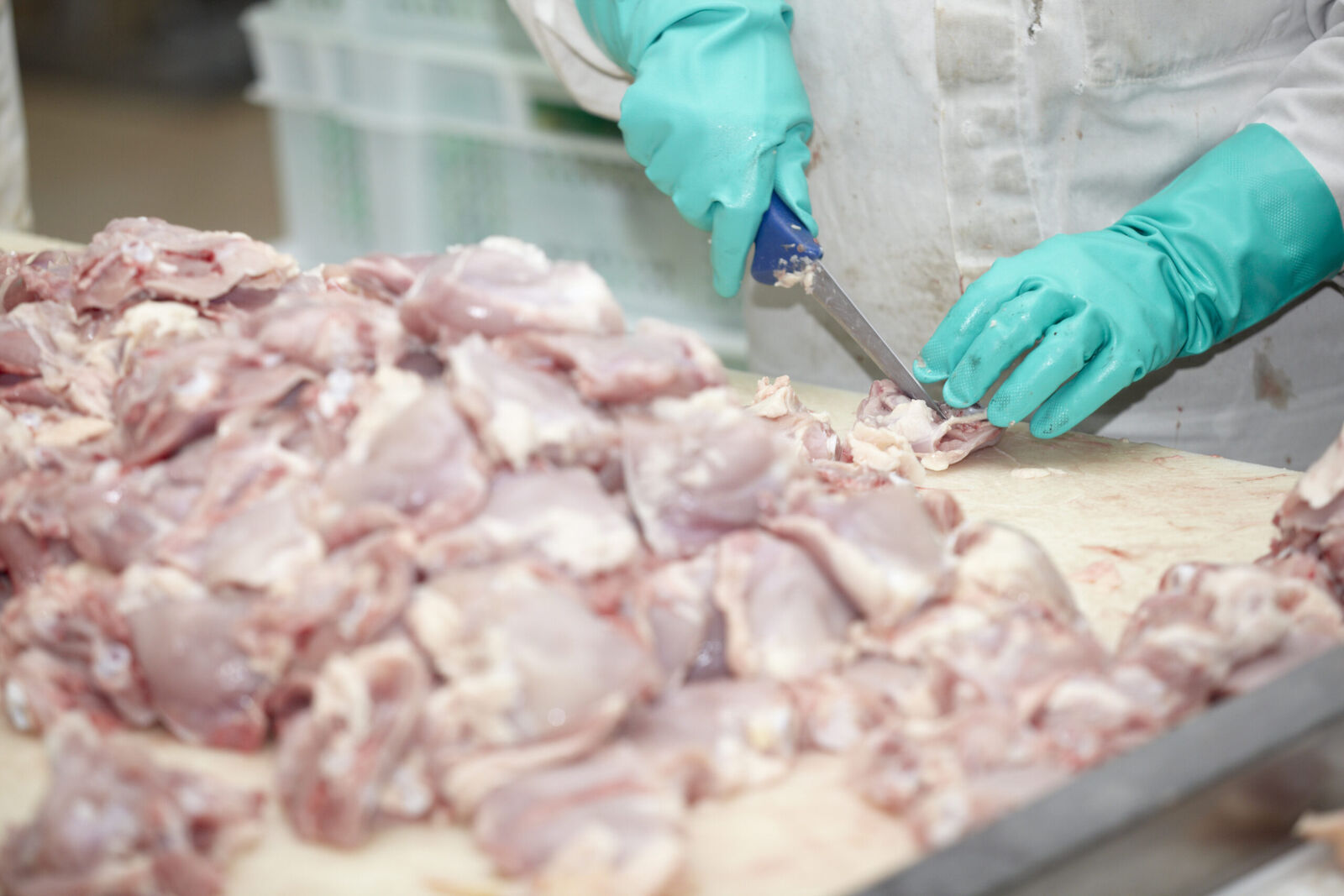
Poultry processing plant worker in protective gear on a fast-moving production line
The Data Behind the Danger

Georgia Poultry-Processing Injury Statistics

The figures below are drawn from the Bureau of Labor Statistics (BLS), OSHA, the Southern Poverty Law Center’s poultry-worker survey, and USDA’s PULSE line-speed study. Together they show why repetitive-motion and chemical injuries dominate this industry — and why so many never make it onto an official injury log.

Poultry-Worker Injuries by Type

Share of reported significant injuries/illnesses
Source: Southern Poverty Law Center, “Unsafe at These Speeds” (survey of 302 poultry workers); OSHA Poultry Processing hazard guidance. Distribution approximate.

What the Workers Say

Findings from the SPLC poultry-worker survey
Source: Southern Poverty Law Center, “Unsafe at These Speeds.” 72% reported a significant work injury/illness; ~76% said line speed makes their work more dangerous.

Recorded Injury Rate Hides the Real Toll

BLS recordable injury/illness rate, poultry slaughter & processing
Source: U.S. Bureau of Labor Statistics (1994 rate 22.7; 2023 rate 2.6). MSDs are widely under-recorded — OSHA’s 300 log has no musculoskeletal-injury checkbox (SPLC).

Top Hazards on the Processing Floor

Hazard categories identified by OSHA in poultry plants
Source: OSHA, Poultry Processing — Hazards & Solutions; USDA FSIS PULSE Study (2024, 11 plants, 1,000+ workers). Counts illustrative of relative emphasis.
Inside the Plant

Common Chicken-Plant Hazards & Injuries

OSHA identifies poultry processing as one of the most hazardous jobs in the country. From the first cut to final pack-out, workers face the same dangers shift after shift — and high line speeds make every one of them worse.

Repetitive-Motion Injuries & MSDs

Deboning and cutting require the same forceful motion tens of thousands of times a day. The result is tendonitis, rotator-cuff tears, trigger finger, and chronic back, shoulder, and elbow musculoskeletal disorders (MSDs) — the most common poultry injury of all.

Carpal Tunnel Syndrome

Repetitive gripping and wrist motion at high line speed compress the median nerve. Studies have found poultry workers face dramatically elevated risk of carpal tunnel and similar nerve disorders — often requiring surgery and permanent work restrictions.

Lacerations from Knives & Blades

Sharp knives, scissors, and powered cutting equipment cause deep cuts to hands, fingers, and forearms. Fast lines, fatigue, and crowded stations turn a slipped blade into a tendon injury, nerve damage, or partial amputation.

Slips & Falls on Wet Floors

Processing uses enormous volumes of water; combined with fat and skin scraps on walkways and stairs, floors become dangerously slick. OSHA flags slips, trips, and falls as a leading cause of serious poultry-plant injuries.

Ammonia & Chemical Exposure

Plants use anhydrous ammonia as a refrigerant. A leak can cause chemical burns, severe respiratory injury, and — at process-safety quantities — catastrophic, even fatal, releases. Cold-side workers are at constant risk.

Peracetic Acid (PAA) Exposure

Peracetic acid, sprayed as an antimicrobial, is a powerful oxidizer. Exposure causes burning eyes, coughing, and irritation of the nose, throat, and lungs. NIOSH and NELP have flagged PAA as an under-regulated respiratory hazard for line workers.

Machinery & Caught-In Injuries

Conveyors, augers, chillers, and powered cutters can crush, amputate, or pull in a worker when guards are missing or lockout/tagout is ignored. These are among the most catastrophic poultry-plant injuries.

Cold, Noise & Fatigue

Hours in refrigerated rooms, deafening equipment noise, and relentless quotas compound every other hazard — worsening MSDs, masking pain, and contributing to long-term hearing loss.

Falls from Pressure to Keep Up

Line-speed and piece-rate pressure discourages workers from stopping to clean spills, fix guards, or report pain. USDA’s PULSE study tied injury risk closely to the volume workers process — the faster the line, the higher the toll.

Why Line Speed Matters

The Faster the Line, the Higher the Toll

In the Southern Poverty Law Center’s survey, roughly three out of four workers said line speed makes their work more dangerous — and identified it as a leading driver of musculoskeletal disorders. USDA’s 2024 PULSE study, which evaluated more than 1,000 workers across 11 plants, linked injury risk to the sheer volume of birds workers process. When quotas come before safety, workers absorb the cost.

Cumulative Trauma Is Still a Work Injury

You don’t need a single dramatic accident. Georgia covers injuries that develop gradually from repetitive job duties. Carpal tunnel, tendonitis, and back injuries built up over months are compensable.

Underreporting Is the Norm

MSDs aren’t even tracked on the OSHA 300 log, and workers are often discouraged from reporting. A low “official” injury rate does not mean the work is safe.

Reporting Pressure Is Not the Law

If a supervisor told you to keep working, see the company nurse only, or that you “can’t” file — that is not Georgia law. You have the right to report and to claim benefits.

Free Case Evaluation

Do You Have a Poultry-Plant Workers’ Comp Claim?

Answer a few quick questions. We’ll tell you whether you may have a Georgia workers’ compensation claim, and a Morrison & Hughes attorney will call you. Free, confidential, no obligation — and your immigration status does not affect your right to benefits.

Step 1 of 6

Were you hurt working at a poultry or processing plant?

This includes injuries that built up over time, like carpal tunnel or a bad back.

Tell us why you are seeking legal advice

A few words about your situation helps us point you to the right attorney. There’s no obligation.

What kind of injury are you dealing with?

Pick the closest match — you can tell us more later.

Did you report the injury to your employer?

Georgia generally requires notice within 30 days (O.C.G.A. § 34-9-80) — but tell us either way.

When did the injury happen (or when did the pain start)?

Georgia’s workers’ comp filing deadline is generally one year (O.C.G.A. § 34-9-82).

Are you currently represented by another attorney for this injury?

If yes, please contact your attorney first.

One last step — send this to our team

Your answers are already written into the message below. Add your contact details, tell us anything else in your own words, and press Send Message. Nothing is sent until you do.

Know the Statutes

Georgia Workers’ Comp Law for Poultry Workers

Georgia’s Workers’ Compensation Act (O.C.G.A. Title 34, Chapter 9) covers virtually every employee — including poultry-plant workers. Your right to benefits does not depend on your immigration status, and it is not your employer’s to give or take away. The statutes below shape what you can recover and how long you have to act.

O.C.G.A. § 34-9-80

30-Day Notice of Injury

You must notify your employer of a work injury — generally within 30 days. Verbal notice counts, but written notice is far better. For repetitive injuries, the clock often runs from when you knew (or should have known) the job caused the harm. Language barriers and supervisors who discourage reporting do not erase your rights.

O.C.G.A. § 34-9-82

One-Year Statute of Limitations

A claim must generally be filed with the State Board of Workers’ Compensation within one year of the accident — or, if benefits were paid, within two years of the last income benefit or one year of the last authorized medical treatment. Miss the deadline and the claim can be barred. Don’t wait.

O.C.G.A. § 34-9-261

Temporary Total Disability (TTD)

If you can’t work, you’re entitled to two-thirds of your average weekly wage, capped at $800 per week for injuries on or after July 1, 2023. For non-catastrophic injuries, TTD can continue up to 400 weeks. Catastrophic injuries can qualify for lifetime benefits.

O.C.G.A. §§ 34-9-200 & 34-9-201

Medical Care & the Posted Panel

Your employer must furnish all reasonably necessary medical treatment and post a panel of physicians (at least 10, including an orthopedist). You choose your treating doctor from that panel and may switch once without permission. You are not limited to the company nurse or first-aid station.

O.C.G.A. §§ 34-9-280 & 34-9-1

Occupational Disease & Repetitive Trauma

Georgia covers more than one-time accidents. Conditions that develop gradually from your job duties — carpal tunnel, tendonitis, and other cumulative-trauma injuries common in deboning and cutting — are compensable when the work is shown to be the cause.

O.C.G.A. § 34-9-265

Death & Dependency Benefits

If a poultry-plant injury is fatal — an ammonia release, a machinery crush, a fall — eligible dependents may recover weekly death benefits and burial expenses. These rights, like all others under the Act, do not depend on the worker’s or family’s immigration status.

Important: Georgia workers’ compensation benefits are available to injured employees regardless of immigration status. It is unlawful for an employer to use a worker’s status to deny a legitimate claim. Everything you tell us is confidential.

Protect Your Claim

What to Do After a Poultry-Plant Injury

What you do in the first days after an injury — or after the pain finally becomes too much to ignore — directly affects what you can recover. The employer’s insurer is already working. Yours should be, too. Don’t let them get a head start. Let us help you protect your case from the very beginning.

1. Report It in Writing

Tell your supervisor and ask for a written report. Keep a copy and the date. For repetitive injuries, report as soon as you connect the pain to your job (O.C.G.A. § 34-9-80).

2. Get Authorized Medical Care

Ask for the posted panel of physicians and choose a treating doctor. You are not limited to the plant nurse. Tell every provider the injury is work-related.

3. Document Everything

Save names of witnesses, your job duties, line speed, photos of the hazard or your injury, and copies of any forms. Detail matters in repetitive-trauma claims.

4. Don’t Sign What You Don’t Understand

Insurers and employers may push forms, recorded statements, or quick “agreements.” If it isn’t in your language or you don’t understand it, don’t sign — call us first.

5. Know You Can’t Be Punished for Filing

Retaliation for a legitimate workers’ comp claim is unlawful — and your immigration status does not change your right to benefits.

6. Call Morrison & Hughes

The sooner we’re involved, the more we can preserve — medical authorization, witness accounts, line records — and the stronger your claim becomes.

Common Questions

Chicken-Plant Injury FAQs — Georgia

Can I file a workers’ comp claim if I’m undocumented?
Yes. Georgia workers’ compensation benefits are available to injured employees regardless of immigration status. Your employer cannot lawfully use your status to deny a legitimate claim, and what you tell our firm is confidential. Many of the workers who built Georgia’s poultry industry are immigrants — the law protects them when they are hurt on the job.
My carpal tunnel built up over years — is that covered?
It can be. Georgia covers repetitive-trauma and occupational-disease injuries, not just one-time accidents (O.C.G.A. §§ 34-9-280, 34-9-1). Carpal tunnel, tendonitis, rotator-cuff injuries, and chronic back conditions from deboning and cutting are compensable when the work is shown to be the cause. The notice and filing clocks for these injuries often run from when you knew the job caused the harm — which is why timing and documentation matter.
How long do I have to report and file in Georgia?
You should report a work injury to your employer within 30 days (O.C.G.A. § 34-9-80). A claim must generally be filed with the State Board of Workers’ Compensation within one year of the injury (O.C.G.A. § 34-9-82) — or, if benefits were paid, within two years of the last income check or one year of the last authorized medical treatment. Don’t wait: deadlines can bar an otherwise valid claim.
My supervisor sent me to the company nurse and told me not to file. What now?
That is not how Georgia law works. You have the right to report the injury, to receive authorized medical care, and to choose a treating doctor from the employer’s posted panel of physicians (O.C.G.A. §§ 34-9-200, 34-9-201) — not just the plant nurse. Pressure or threats to discourage reporting do not erase your rights, and retaliation for filing is unlawful. Call us and we’ll handle the employer.
How much will I be paid if I can’t work?
If your injury keeps you out of work, you’re generally entitled to two-thirds of your average weekly wage, up to a maximum of $800 per week for injuries on or after July 1, 2023 (O.C.G.A. § 34-9-261). For non-catastrophic injuries these temporary total disability benefits can continue up to 400 weeks; catastrophic injuries may qualify for lifetime benefits. You may also be owed permanent partial disability based on your impairment rating.
What if I was exposed to ammonia or peracetic acid?
Chemical exposure is a workplace injury. Anhydrous ammonia (a refrigerant) and peracetic acid (an antimicrobial spray) can cause chemical burns and serious respiratory injury. OSHA, NIOSH, and NELP have all flagged these as significant poultry-plant hazards. Get medical care, make sure the exposure is documented as work-related, and let us pursue your medical and wage benefits — and investigate whether safety failures contributed.
Is it free?
Nothing up front. In Georgia, workers’ compensation attorney’s fees are set and capped by law — generally 25% — and must be approved by the State Board of Workers’ Compensation. The fee comes out of the benefits we secure, and the initial consultation is always free and confidential, so there’s no risk in calling.

Hurt at a Georgia Chicken Plant? Call Now.

Free, confidential consultation — 24/7. We’ll listen, tell you whether you have a claim, and walk you through what comes next. Se habla español. Your immigration status does not affect your right to benefits.

404-LAW-TEAM

(404-529-8326)

Request a Free Consultation
Skip to content