
Free & Confidential Consultation • Proudly Standing With Organized Labor • Hablamos Español
Home > Workers’ Compensation > Plant, Factory & Warehouse Injuries
Industrial Workers’ Comp Attorneys

Georgia Plant, Factory & Warehouse Injury Lawyers

You Build Georgia. We Stand Up For You.

Manufacturing plants, distribution warehouses, and factory floors run on speed and pressure — and when a machine, a forklift, or a fall puts you on the ground, your employer’s insurer goes to work protecting itself. Morrison & Hughes fights to get injured industrial workers the workers’ compensation benefits Georgia law guarantees.

We handle denied & delayed claims
Statewide Georgia representation
6 office locations
0
Manufacturing Injury Cases
Nonfatal recordable cases, 2023 (BLS SOII)
0
Warehouse Injury Rate
Per 100 workers, transp. & warehousing 2023 (BLS)
0
Manufacturing Deaths
Fatal work injuries, 2023 (BLS CFOI)
0$
GA Weekly TTD Max
Injuries on/after 7/1/2023 (O.C.G.A. § 34-9-261)
Representing Injured Industrial Workers Across Georgia

When the Line Doesn’t Stop for Your Injury, We Will.

Georgia’s plants, factories, and warehouses are some of the most dangerous workplaces in the state. Conveyor systems, presses, forklifts, palletizers, and chemical processes operate around the clock — and a single moment of unguarded machinery, a loose load, or a wet dock can leave a worker with crushed fingers, a torn back, an amputation, or worse.

Nearly every Georgia industrial employer carries workers’ compensation insurance, which means you should not have to prove your employer was at fault to recover. But “no-fault” does not mean “no fight.” Insurers routinely deny claims, dispute whether an injury is work-related, push you back to work too soon, or steer you to a company doctor who minimizes your condition.

Morrison & Hughes Law Firm represents injured plant, factory, and warehouse workers throughout Georgia — from the metro Atlanta distribution corridor to the manufacturing towns of the Piedmont and West Georgia. We document the injury, protect your medical treatment, secure your weekly checks, and pursue every additional source of recovery, including third-party claims against equipment manufacturers.

Tell Us What Happened
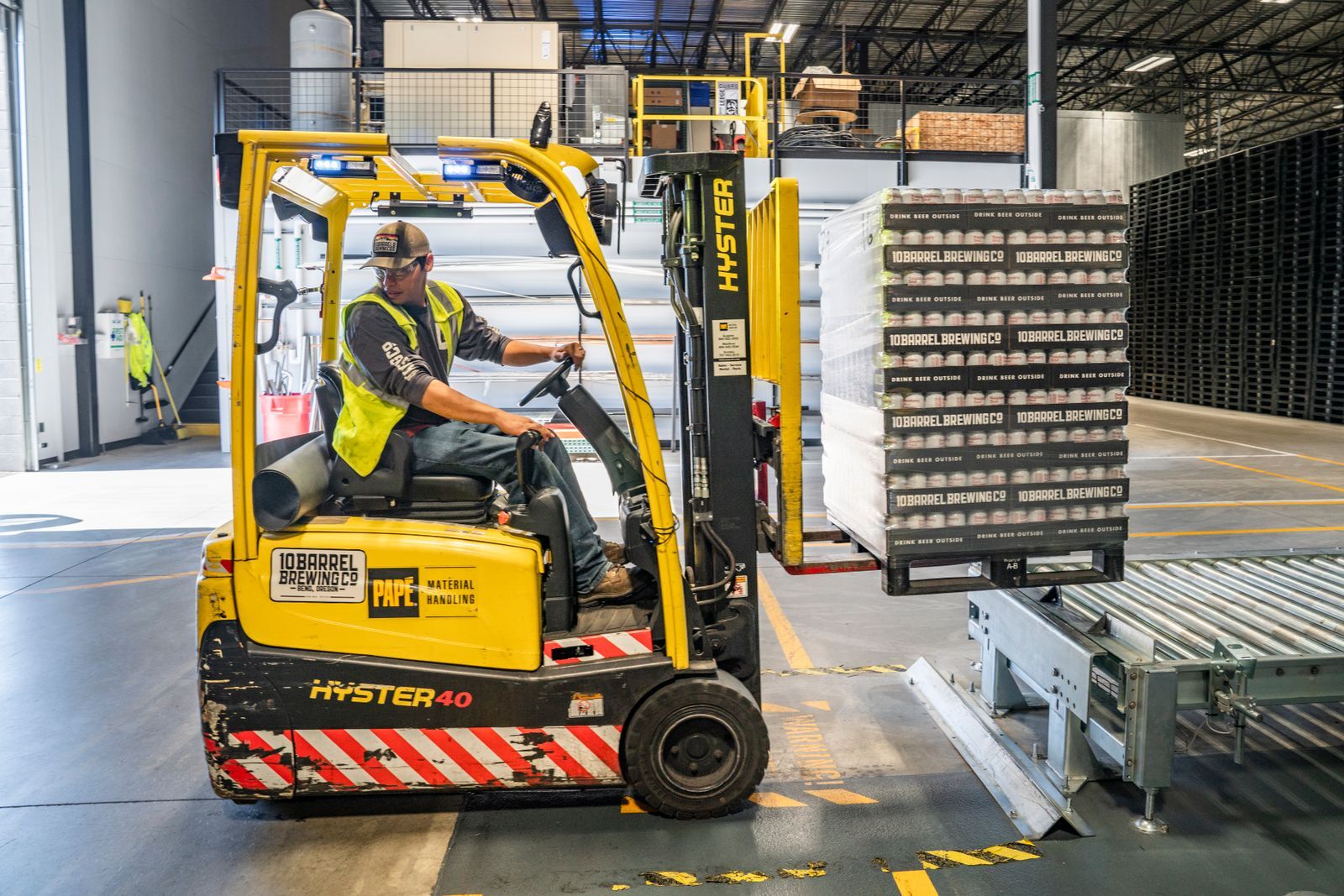
Worker on a Georgia factory and warehouse floor surrounded by industrial machinery
The Data Behind Industrial Injuries

Plant, Factory & Warehouse Injury Statistics

The numbers below come from the U.S. Bureau of Labor Statistics (BLS), OSHA, and the National Safety Council. They show why industrial work is high-risk — and why injured Georgia workers need representation that understands these hazards.

Injury Rate by Industry

Total recordable cases per 100 full-time workers, 2023
Source: BLS Survey of Occupational Injuries & Illnesses, 2023 — all private industry 2.4; manufacturing 2.8; transportation & warehousing 4.5 per 100 FTE.

OSHA’s Most-Cited Industrial Hazards

FY2024 citations in general industry
Source: OSHA Top 10 Most Frequently Cited Standards, FY2024 — Lockout/Tagout (#5), Powered Industrial Trucks / forklifts (#6, ~2,248), Machine Guarding (#10).

How Industrial Workers Get Hurt

Leading events causing days-away/restricted cases
Source: BLS SOII, 2021–22 — overexertion & bodily reaction was the leading event for days-away/restricted/transfer (DART) cases (1,001,440).

What Kills Manufacturing Workers

Leading fatal events, manufacturing, 2023
Source: BLS Census of Fatal Occupational Injuries, 2023 — 391 manufacturing deaths; contact with objects/equipment (120) the leading event; ~67 U.S. forklift deaths (NSC).
How Industrial Workers Get Hurt

Common Plant, Factory & Warehouse Hazards

Whether you run a press, drive a forklift, pick orders, or work a chemical line, the dangers are well documented — and so are the OSHA standards meant to control them. When a hazard isn’t controlled, workers pay the price.

Machine Entanglement & Caught-In/Crush

Unguarded presses, rollers, conveyors, augers, and rotating shafts amputate fingers and hands and crush limbs. Machine guarding and lockout/tagout failures are among OSHA’s most-cited industrial violations — and a frequent cause of factory amputations.

Forklift & Powered-Truck Accidents

Forklifts, reach trucks, and pallet jacks tip over, strike workers on foot, and drop loads. Powered industrial trucks ranked #6 on OSHA’s FY2024 Top 10 (about 2,248 citations); the National Safety Council reports roughly 67 forklift deaths nationwide in 2023.

Falls — Same-Level & From Height

Slick docks, spilled product, mezzanines, ladders, and loading-dock edges cause serious falls. Fall protection has topped OSHA’s most-cited list for over a decade — and falls remain a leading cause of warehouse and plant injuries.

Repetitive Motion & MSDs

Lifting, twisting, packing, and assembly-line repetition tear backs, shoulders, and wrists. Overexertion and bodily reaction is the single leading cause of days-away/restricted injuries in the U.S. (BLS) — and these strains are covered under Georgia’s repetitive-trauma rules.

Chemical & Toxic Exposure

Solvents, acids, ammonia, isocyanates, silica, and combustible dust cause burns, respiratory damage, and occupational disease. Hazard Communication is consistently a top-cited OSHA standard. Exposure illnesses can be compensable even when they develop over time.

Heat Illness & Overheating

Foundries, bakeries, plastics plants, and un-air-conditioned warehouses push workers into heat exhaustion and heat stroke — sometimes fatally. Heat injuries that arise out of the job are work-related and compensable under Georgia law.

What Industrial Work Does to the Body

Common Industrial Worker Injuries

Plant, factory, and warehouse injuries range from a single catastrophic accident to slow-building damage from years on the line. All of them can entitle you to Georgia workers’ compensation benefits.

Amputations & Crush Injuries

Fingers, hands, and limbs lost or crushed in presses, rollers, and conveyors. These cases involve scheduled-member PPD benefits and often a third-party claim against the equipment maker.

Back & Spinal Injuries

Herniated discs, fractures, and chronic strain from lifting, twisting, and repetitive loading. Back injuries are among the most common — and most disputed — industrial claims.

Repetitive-Trauma & MSDs

Carpal tunnel, rotator-cuff tears, tendinitis, and cumulative trauma disorders from years of assembly-line work — covered under Georgia’s occupational-disease and repetitive-trauma rules.

Fractures & Broken Bones

Falls from docks and mezzanines, dropped loads, and forklift strikes break legs, arms, ribs, and pelvises — often requiring surgery and months off the line.

Burns & Chemical Injuries

Thermal burns from hot machinery and foundry work, chemical burns, and respiratory injury from solvents, ammonia, dust, and fumes — including occupational lung disease.

Traumatic Brain & Catastrophic Injuries

Struck-by impacts, falls, and forklift collisions cause TBIs, paralysis, and other catastrophic harm — which can unlock lifetime medical and income benefits.

Free Claim Check

Do You Have a Georgia Workers’ Comp Claim?

Answer a few quick questions. We’ll tell you whether you likely have a workers’ compensation claim, and a Morrison & Hughes attorney will call you. Free, confidential, no obligation.

Step 1 of 6

Were you hurt at a plant, factory, or warehouse?

A sudden accident or a repetitive-strain injury that built up over time both count.

Tell us why you are seeking legal advice

A few words about your situation helps us point you to the right attorney. There’s no obligation.

Were you working when it happened?

Georgia workers’ comp is no-fault — you generally don’t have to prove your employer did anything wrong.

Did you report the injury to your employer?

Georgia requires notice within 30 days (O.C.G.A. § 34-9-80) — but report it now even if time has passed.

When did the injury happen?

Georgia’s filing deadline is generally one year from injury or last authorized treatment (O.C.G.A. § 34-9-82).

Are you already represented by another attorney for this injury?

If yes, please contact your current attorney first.

One last step — send this to our team

Your answers are already written into the message below. Add your contact details, tell us anything else in your own words, and press Send Message. Nothing is sent until you do.

Know the Statutes

Georgia Workers’ Compensation Law for Industrial Injuries

Georgia’s Workers’ Compensation Act (O.C.G.A. Title 34, Chapter 9) controls what you can recover, where you can treat, and how long you have to act. Missing a deadline can end your claim before it starts.

O.C.G.A. § 34-9-80

30-Day Notice of Injury

You must notify your employer of a work injury within 30 days. Report it in writing and keep a copy. Failing to give timely notice can bar your claim unless the employer already had actual knowledge or an exception applies.

O.C.G.A. § 34-9-82

One-Year Statute of Limitations

A claim generally must be filed within one year of the accident — or within one year of the last authorized medical treatment or income benefit paid by the employer. This deadline is far shorter than in personal-injury cases.

O.C.G.A. § 34-9-261

Temporary Total Disability (TTD)

If you can’t work, TTD pays two-thirds of your average weekly wage, capped at $800/week for injuries on or after July 1, 2023. Non-catastrophic TTD is generally limited to 400 weeks; catastrophic cases can extend longer.

O.C.G.A. § 34-9-263

Permanent Partial Disability (PPD)

When you reach maximum medical improvement with a lasting impairment — such as the loss or loss of use of a hand, arm, leg, or back — the statutory schedule of benefits sets additional weeks of pay based on your impairment rating.

O.C.G.A. §§ 34-9-200 & 34-9-201

Medical Care & the Posted Panel

Authorized medical treatment is 100% covered with no co-pays or deductibles. Employers must post a valid panel of physicians (at least six providers); if the panel is invalid or not posted, you may have the right to choose your own doctor.

O.C.G.A. § 34-9-280 et seq. / § 34-9-1(4)

Occupational Disease & Repetitive Trauma

Georgia covers occupational diseases and gradual repetitive-trauma injuries — carpal tunnel, back strain, chemical exposure, and hearing loss can be compensable even when there’s no single accident, subject to specific proof and notice rules.

Third-Party Liability — Beyond Workers’ Comp

When Someone Other Than Your Employer Is at Fault

Workers’ comp is generally your exclusive remedy against your employer — but it does not bar a separate third-party personal-injury claim against a non-employer who caused your injury. If a defective press, forklift, or guard failed, the equipment manufacturer may be liable; if a contractor or delivery driver hurt you on site, they may be too. These claims can recover pain and suffering and full lost earnings that workers’ comp does not pay — and we pursue both tracks together.

What Georgia Workers’ Comp Pays

Benefits Available to Injured Industrial Workers

A properly handled claim should cover far more than a few doctor visits. We make sure every benefit you’re owed is on the table.

  • All authorized medical treatment, surgery, and rehabilitation
  • Prescription medication and necessary medical devices
  • Temporary total disability (TTD) weekly income — up to $800/week
  • Temporary partial disability (TPD) for reduced-earnings light duty
  • Permanent partial disability (PPD) under the statutory schedule
  • Catastrophic-injury benefits for the most serious cases
  • Mileage reimbursement to and from medical appointments
  • Vocational rehabilitation where applicable
  • Death and dependent benefits in fatal-injury cases
  • Negotiated lump-sum settlement of your claim
  • Third-party recovery against equipment makers or contractors
  • Protection against retaliation for filing a claim
Common Questions

Plant, Factory & Warehouse Injury FAQs — Georgia

How long do I have to report and file a Georgia workers’ comp claim?
Two deadlines matter. First, you must notify your employer within 30 days of the injury under O.C.G.A. § 34-9-80. Second, you generally must file your claim within one year of the accident — or within one year of the last authorized medical treatment or weekly check paid by the employer — under O.C.G.A. § 34-9-82. Because these deadlines are short and strictly enforced, report your injury right away and call an attorney if you have any doubt.
Do I have to prove my employer did something wrong?
No. Georgia workers’ compensation is a no-fault system. As long as the injury arose out of and in the course of your employment, you can recover benefits even if the accident was partly your own fault — and even if no one was negligent. You also generally cannot be denied because a co-worker or a machine, rather than the employer, caused the harm.
Can I see my own doctor, or do I have to use the company doctor?
Under O.C.G.A. §§ 34-9-200 and 34-9-201, your employer must post a valid panel of physicians — at least six providers — and you choose from that panel and may make one change to another panel doctor. If the panel is not properly posted, is invalid, or you weren’t told about it, you may be entitled to treat with a physician of your own choosing. We routinely challenge defective panels.
How much will my weekly check be?
Temporary total disability (TTD) pays two-thirds of your average weekly wage, subject to a state maximum of $800 per week for injuries on or after July 1, 2023 (O.C.G.A. § 34-9-261). If you return to light duty at lower pay, temporary partial disability (TPD) makes up part of the difference. Insurers often miscalculate the average weekly wage — we audit it to make sure your check is correct.
Is a repetitive-strain or chemical-exposure injury covered if there was no single accident?
Often, yes. Georgia recognizes occupational diseases and repetitive-trauma injuries — conditions like carpal tunnel, cumulative back injury, hearing loss, and exposure-related illness that develop over time on the job. These claims have specific proof and notice requirements, and insurers fight them hard, so documentation and medical opinion linking the condition to your work are critical.
Can I sue the company that made the machine that hurt me?
Possibly. Workers’ comp is generally your exclusive remedy against your employer, but it does not block a separate third-party claim against a non-employer at fault — such as the manufacturer of a defective forklift or unguarded press, or an outside contractor on the site. A third-party case can recover pain and suffering and full lost wages that comp doesn’t pay. We evaluate both at once.
What if my claim was denied or my benefits were cut off?
A denial is not the end. You can request a hearing before the State Board of Workers’ Compensation, where we present medical evidence and testimony to an administrative law judge. Common disputes — whether the injury is work-related, whether you can return to work, and the average weekly wage — are exactly what we litigate. Call us before you accept a denial or sign anything.
From the Morrison & Hughes Blog

Industrial Injury Resources

Practical guidance for Georgia plant, factory, and warehouse workers, written by attorneys who fight for them. Read these before you talk to the insurance adjuster.

Visit the Morrison & Hughes Blog

Related Practice Areas

Service Areas: Find Your Local Workers’ Comp Attorney

We handle plant, factory & warehouse injury cases statewide. Six office locations across Georgia.

Hurt at a Georgia Plant, Factory, or Warehouse? Call Now.

Free, confidential consultation — 24/7. We’ll protect your medical treatment, secure your weekly checks, and pursue every source of recovery.

404-LAW-TEAM

(404-529-8326)

Request a Free Consultation
Skip to content