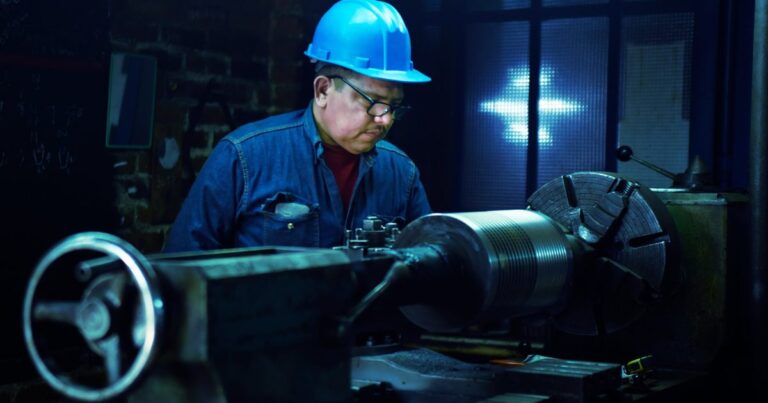

A workplace amputation injury happens when a worker loses a body part in an accident. Amputations can involve fingers, toes, hands, feet, legs, and arms — and, whatever the severity, the result is always life-changing.
The good news: with modern prosthetics and the workers’ compensation benefits available in Georgia, our attorneys can help restore a sense of normalcy while protecting your family’s financial stability.
How Do Workplace Amputations Happen?
Workplace amputations most often occur in environments where heavy machinery and moving equipment are used. In manufacturing settings, presses, conveyors, and forklifts all pose serious risks. Several factors drive these injuries.
-
Skipped Lockout/Tagout Procedures
Many amputations happen when a worker tries to clear a jam or perform maintenance without properly shutting down the equipment. “Lockout/tagout” is the safety procedure that ensures a machine is shut down and cannot be restarted until the work is complete.
-
Inadequate Safety Guards
Missing or inadequate guards and barriers expose workers to moving parts, dramatically increasing the risk of amputation.
-
Poor Training and Neglected Safety Procedures
Insufficient training and disregard for proper safety protocols worsen every other hazard, leaving employees vulnerable to severe injuries.
-
Human Error and Fatigue
Distracted or fatigued workers may skip safety steps and place themselves in dangerous situations. Vehicles like forklifts and automated guided systems can cause amputations when operated by uncertified individuals.
-
Poor Lighting or Cluttered Workspaces
Bad lighting and clutter increase the chance of slipping or falling into hazardous equipment.
What Kind of Insurance Claims Can I Make After a Workplace Amputation?
If you’ve suffered an amputation on the job, you are entitled to file a workers’ compensation claim. Under Georgia law, this is often called the “exclusive remedy” — meaning that even if your employer or a coworker was negligent or reckless, you generally cannot sue them for personal injury. Instead, you receive workers’ compensation benefits.
The Trade-Off — and the Upside
Workers’ compensation does not cover certain damages, such as pain and suffering. That can be frustrating for injured workers.
But there’s a major upside: workers’ compensation has no “policy limits.” Your medical care — including the lifetime cost of prosthetics — is covered by insurance. That’s unlike a personal-injury claim, where compensation may be capped or the at-fault party might declare bankruptcy.
Can I File a Personal Injury Claim After a Workplace Amputation?
Yes — in certain cases. Although workers’ compensation is your exclusive remedy against your employer, you can file a separate personal-injury claim against third parties responsible for your injury. That may include the manufacturer of faulty machinery, the installer, or an outside company responsible for maintenance or safety mechanisms.
A skilled attorney will investigate every potential legal avenue to make sure the right claims are filed against the correct parties — so you recover everything you’re owed from every responsible source.
Prosthetic Options After a Workplace Amputation
In many cases a severed limb cannot be reattached, and workers must rely on prosthetics. Workers’ compensation insurance covers them — and they range widely in type and function. (In one Morrison & Hughes case, a client received custom prosthetic fingers to replace lost digits.)
- Passive prosthetics: Primarily aesthetic — designed to look like the lost limb, generally with no functional movement.
- Body-powered prosthetics: Use cables and harnesses to mimic movement. For example, a body-powered ring finger may bend and extend in tandem with the adjacent finger.
- Electrical prosthetics: Powered by motors and batteries, allowing movement without manual input.
- Hybrid prosthetics: Combine body-powered and electrical elements for greater functionality.
- Activity-specific prosthetics: Built for a specific task — holding a bat, or performing a particular job function.
Are Prosthetics Expensive?
Yes — prosthetics can be very costly, especially advanced hybrid or bioelectric models. Health insurance may not cover the best options, but workers’ compensation insurance covers even the most sophisticated prosthetics. Finger and toe amputations are somewhat unique, because a separate prosthetic is required for each missing digit — so the billing on a case involving several lost digits adds up quickly.
A few important points about prosthetics under Georgia workers’ compensation:
- Since 2019, insurers must provide prosthetics for your entire life.
- You may be entitled to more than one type of prosthetic at the same time (for example, a passive prosthetic for daily use and a functional one for work).
- Prosthetics wear out over time and may need replacing as often as every two years.
Seek Compensation to Pay for Your Prosthetic
If you’ve experienced an amputation at work, you shouldn’t have to bear the cost of prosthetics on your own. You may be able to file a workers’ compensation claim — and, in some cases, a third-party personal-injury lawsuit — to cover your injuries and the ongoing cost of prosthetics. At Morrison & Hughes, we’ve recovered over $300 million for our clients. Let us help you pursue the compensation you deserve.
Prior results do not guarantee a similar outcome. Every case is different, and the amount recovered depends on the specific facts and circumstances.
Injured in a Workplace Amputation? Let Us Handle the Claims.
Free, confidential case review. We’ll pursue every source of compensation — workers’ comp and any third-party claim.
Call 404-LAW-TEAM or contact us online for a free, confidential case review.