
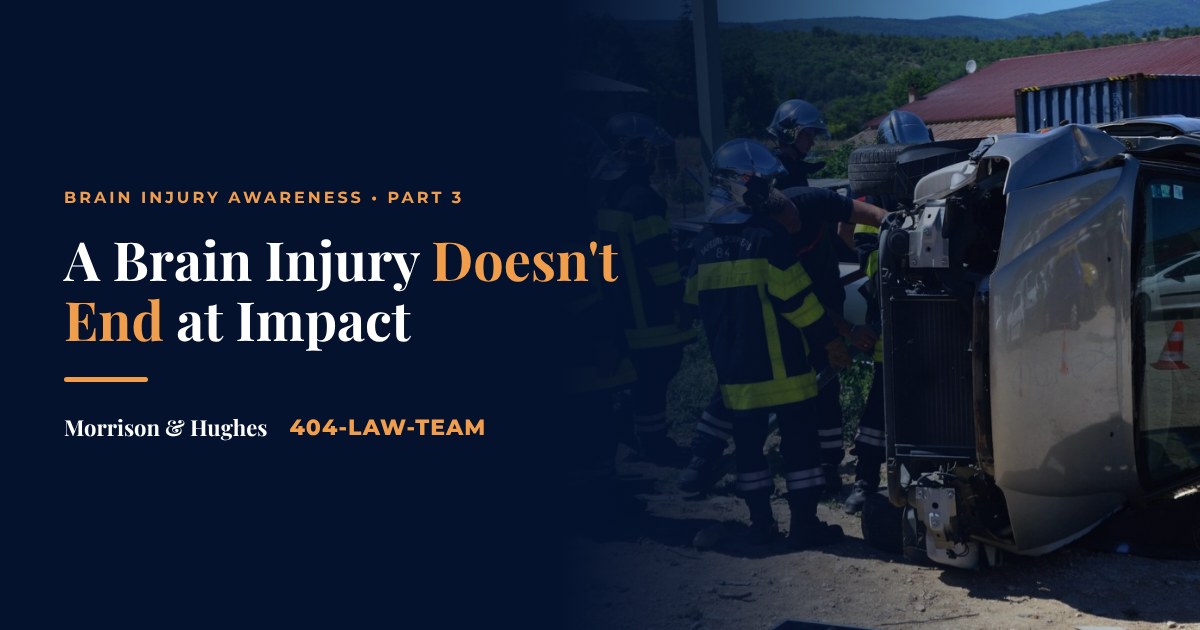
Most people think of a brain injury as something that happens in an instant. There is the crash, the jolt, and then it is over. Brain science tells a different story. A traumatic brain injury is not just the moment of impact. It is an evolving biological process that can unfold over hours, days, months, or even years.
The Primary Injury: The Moment of Impact
The primary injury is the damage caused by the mechanical force of the crash itself. It can include concussion, bruising of brain tissue (contusions), bleeding, diffuse axonal injury (stretching and tearing of nerve fibers), and coup-contrecoup injuries, where the brain strikes one side of the skull and then the other.
In a car crash, much of that force comes from rapid acceleration and deceleration, the same whipping motion that strains the neck. You can see how strong those forces can be, even at low speed, with our Low-Speed Impact Calculator.
The Secondary Injury: What Happens Next
After the primary injury, the brain can enter a cascade of biochemical and physiological changes. Researchers describe a long list of processes that may follow, including:
Inflammation
The brain's immune response can stay switched on, contributing to ongoing damage and lingering symptoms.
Blood flow problems
The brain may lose its ability to regulate its own blood supply, leaving some areas without enough oxygen.
Energy failure
Injured cells may struggle to produce energy and to use glucose normally.
Barrier breakdown
The blood-brain barrier can become leaky, letting in substances that do not belong in brain tissue.
Other effects can involve hormones, sleep, mood, balance, and the neck. That is why one injury can lead to many different symptoms.
A Simple Way to Picture It: Rust After a Dent
Think about what happens to a car after a crash. The dent is the visible damage. Underneath, the paint is cracked and the bare metal is exposed. If no one treats it, moisture gets in and rust slowly spreads, eventually weakening parts that were never hit.
Secondary brain injury works in a similar way. The trauma creates vulnerability, and ongoing biological processes can worsen function over time if the injury is not recognized and managed. Early care is like putting primer on damaged metal before rust has a chance to spread.
The key point: the primary injury may be unavoidable, but the secondary injury is often preventable, treatable, and modifiable. What happens after the impact matters.
The Timeline Is Longer Than Most People Expect
A brain injury can move along a continuum:
- Seconds: the crash and the primary injury.
- Hours to days: the secondary cascade begins.
- Days to weeks: delayed symptoms may appear or worsen.
- Months to years: some people experience persistent symptoms or long-term complications.
This is exactly why the days and weeks after a crash are so important, both for your recovery and for documenting your injury.
Your Recovery Should Not Be Rushed
Insurers often push for a quick settlement before the full picture is clear. Morrison & Hughes can help you slow down and protect your claim.
Steps That Can Help Change the Outcome
After Any Crash With Possible Head Injury
- Get evaluated promptly, and go back if symptoms change or worsen.
- If symptoms persist, ask about follow-up care such as neurology, vestibular therapy, or vision therapy.
- Follow guidance on rest, gradual activity, and sleep.
- Track symptoms daily so your care team can see patterns.
- Do not sign a settlement until you understand your long-term needs.
Frequently Asked Questions
What is the difference between a primary and a secondary brain injury?
Can secondary brain injury be prevented?
Why does this matter for an injury claim?
Surviving the Impact Is Just the Beginning
If you were injured in a Georgia car accident and your symptoms seem to be getting worse instead of better, you are not imagining it. Start by running your crash through our free impact calculator, then call Morrison & Hughes at 404-LAW-TEAM for a free, confidential consultation. There is no fee unless we win your injury case.
Sources
- Silverberg ND, Iverson GL, et al. The American Congress of Rehabilitation Medicine Diagnostic Criteria for Mild Traumatic Brain Injury. Arch Phys Med Rehabil. 2023;104(8):1343–1355.
- Centers for Disease Control and Prevention. Traumatic Brain Injury & Concussion data.
- Morrison & Hughes. Low-Speed Impact Injury Analysis.