
Since the turn of the 21st century, we've seen technology reshape not just how we live but how we do business — and the field of law is not immune. By embracing new tools, lawyers can change the way we present arguments and engage jurors with interactive exhibits and experiences. Here's how a few emerging technologies are already changing litigation.
Electronic Court Filing
In a push to go paperless, courts now let claimants and lawyers submit documents through online "e-filing," making legal proceedings far more efficient — especially for those who can't easily get to the courthouse. Newer systems can display a case as a timeline, from when it was opened to exactly when each document or statement was introduced, and some support internal linking: reading an update that references "Exhibit F," a lawyer can click straight to that affidavit instead of digging through boxes of documents. That frees up energy for strategy and presentation.
Blockchain Technology
Blockchain — a decentralized digital ledger of peer-to-peer transactions — has practical uses in law, particularly because it accommodates "smart contracts" whose terms execute automatically. That makes it useful for setting up "low-trust" contract relationships, where one party worries the other won't or can't perform.
Imagine Party A hires Party B for three tasks, paid as each is completed. Party A links her financial institution to a blockchain contract; the funds are set aside (so Party B has no risk of non-payment), and the information is encrypted (so Party A has no risk). Each task is tied to a digitally verifiable condition — a file upload, an ERP transaction, a document filed to a server — and once the condition is met, the contract itself, not a person, verifies it and pays Party B. Because the contract lives in a distributed, tamper-resistant database, there's no file to lose or delete, and minimal ability for anyone to commit fraud by changing the terms.
3D Printing
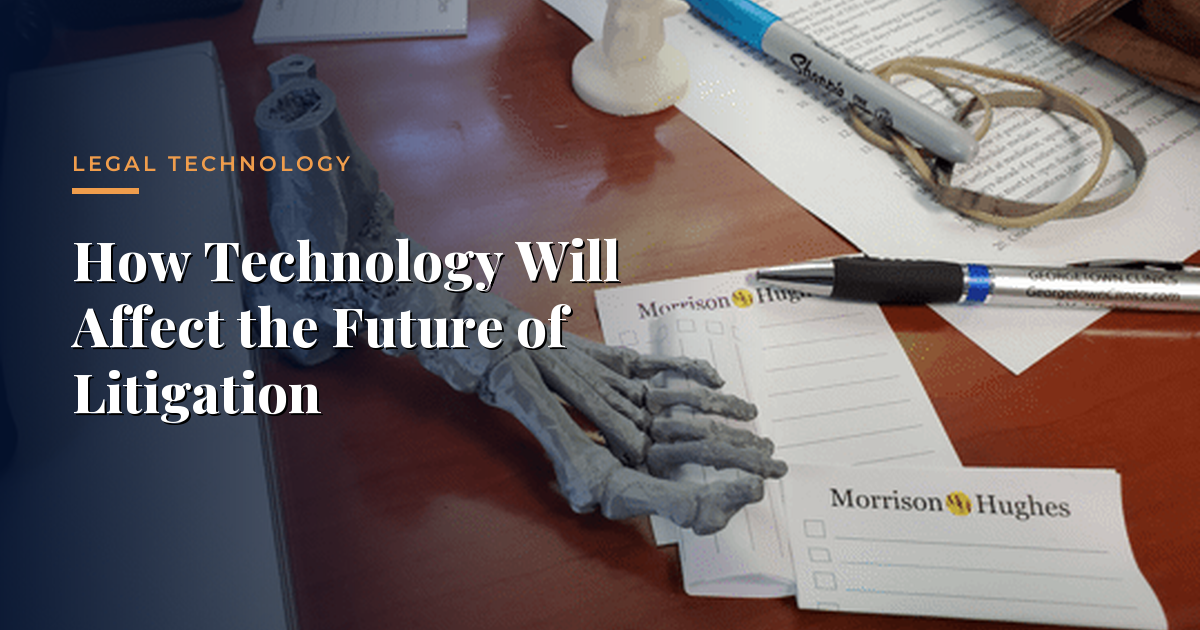
A 3D printer builds complex shapes by extruding molten plastic layer by layer from a computer-aided design. It may not seem legal at first glance, but it's a big benefit for lawyers who handle personal injury, assault, or car accident cases — cases that turn on the type and extent of injuries. A tangible model conveys severity far better than after-the-fact photos and retellings: from a CT scan or MRI, a lawyer can print a 3D model of a broken bone to be examined and handled in the courtroom, or a model of the accident itself.
Virtual Reality
Virtual reality creates simulated experiences of the real world, letting a user visualize moments that would otherwise be unattainable. Arguing a case, a lawyer could recreate an incident in the very place it occurred, giving a jury a far more immersive perspective. One day, jurors may be "transported" to the scene of an incident for a firsthand view of how events allegedly transpired.
Video Presence
Video chat is becoming more common in pre-litigation and, increasingly, the courtroom. Some states now allow video-conference technology to replace personal appearance for notaries; some lawyers attend inspections remotely or bring in specialized, out-of-state experts. The upside is obvious — lower travel costs and more flexibility in choosing an expert — with the caveat that an expert who is physically present is still more credible to a jury. In the future, we may see "live" video-conference court appearances supplant the dry, recorded videotaped deposition; a live witness, even over video, is more dynamic and better able to address questions as they arise at trial.
What's to Come
As technology advances, courtrooms will keep changing — the courtroom of 2050 will look nothing like today's. We may even see physical juries replaced by jurors who "log in" with access to tools we're only beginning to design. It's an exciting time to be an attorney, and staying aware of new technology — and embracing it — is critical to building a successful practice.